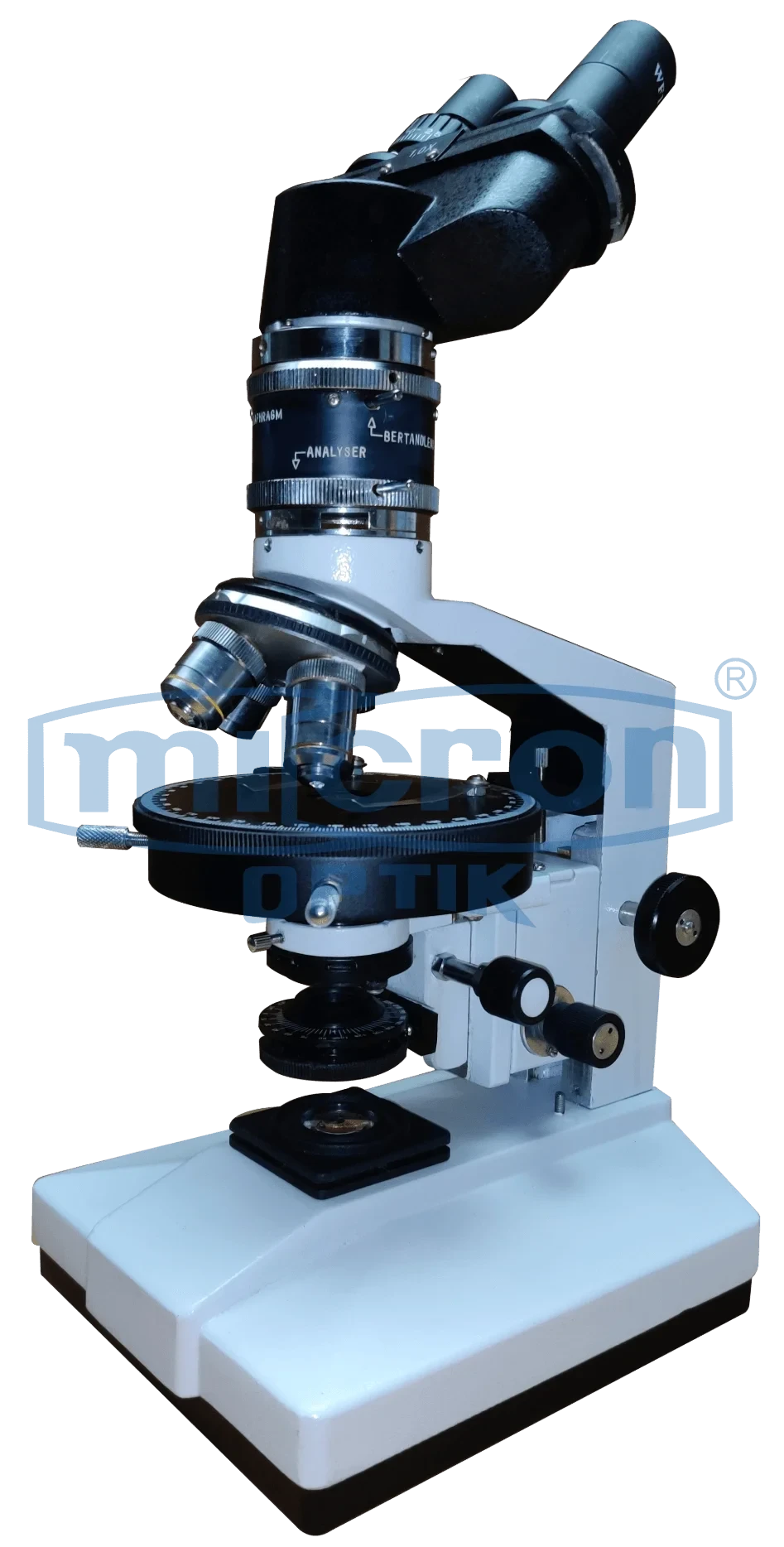
1. Viewing tube: As per Requirement
2. Head Rotatable at 360 degrees.
3. Triple nose piece with positive click stops.
4. Separate Coarse & Fine focusing Graduated to 1Div=.002mm.
5. Circular stage, rotatable in 360 degrees, graduated with vernier reading up to 0.1 degrees with provision for centering by two knobs located just below the circular stage
6. Polarizing with the swing-out system, Compact analyzer head having iris diaphragm, Bertrand lens, Analyser rotating ring, and half/full-wave compensator with following optical combination
EYE PIECES: 10X & 15X
OBJECTIVES:5X, 10X, 45X S/L
1. Wooden Carrying Case
2. Objectives: X20, X60 S/L
A polarizing microscope is a petrographic microscope used in the field of science and medicine. These polarizing microscopes works on the concept of light transmission which permits the view to see enlarged specimens of the geological objects. These microscopes make use of polarized light to see Optikal images. Unlike an Optikal microscope, it comes with additional features including illumination of the sample under study.
Micron's Polarizing Microscope is a specialized instrument designed for the study of birefringent materials, making it an indispensable tool in geology, mineralogy, and materials science. The viewing head is available in binocular and trinocular configurations and is rotatable 360 degrees. This model is widely considered one of the best polarizing microscopes for educational and research applications in earth sciences.
The stage also has provision for centering by two knobs located just below it. For geology departments seeking a top rated petrographic microscope for mineral identification, this model is an excellent choice. The polarizing system includes a swing-out polarizer below the stage and a compact analyzer head above.
The analyzer head is a sophisticated component containing an iris diaphragm, a Bertrand lens for conoscopic observation, an analyzer rotating ring, and half/full-wave compensators (often a quartz wedge or mica plate). These features make it one of the best instruments for determining the optical properties of minerals, such as interference figures and sign of elongation. The optical combination includes 10X and 15X eyepieces and 5X, 10X, and 45X S/L objectives, providing a useful magnification range for examining thin sections and mineral grains. Micron has finished the microscope in a durable, chemical-resistant finish. This model is a top rated choice for any laboratory involved in the identification and characterization of crystalline materials. From analyzing rock thin sections to identifying synthetic fibers and pharmaceutical crystals, Micron's polarizing microscope delivers the specialized optical performance required. The inclusion of a Bertrand lens and compensators allows for advanced petrographic techniques, making it a complete solution for polarization microscopy.
Rotatable 360-Degree Circular Stage: The 150mm circular stage rotates 360 degrees and features a vernier scale accurate to 0.1 degrees, essential for measuring extinction angles in minerals.
Stage Centering Controls: Two knobs located below the circular stage allow for precise centering of the stage rotation axis to the optical axis, critical for accurate conoscopic observations.
Advanced Analyzer Head: The compact analyzer head contains an iris diaphragm, a focusing Bertrand lens, a rotating analyzer, and a slot for full/half-wave compensators.
Swing-Out Polarizer: The polarizer is mounted in a swing-out mechanism, allowing for quick transition between plane-polarized and crossed-polarized light observation.
Bertrand Lens for Conoscopy: The included Bertrand lens allows for conoscopic observation, enabling the user to view interference figures to determine the optic sign and other properties of minerals.
Separate Coarse and Fine Focus: Independent coarse and fine focusing knobs with 0.002mm divisions provide the precision needed to focus on the exact plane of a thin section.
Strain-Free Objectives: The objectives (5X, 10X, 45X S/L) are specially designed to be strain-free, ensuring that they do not introduce artifacts into the polarized light image.
360-Degree Rotatable Viewing Head: The binocular or trinocular head can be rotated 360 degrees, allowing the user to find the most comfortable viewing position for long periods of analysis.
Geology and Petrology: Essential for identifying minerals in rock thin sections by observing their optical properties such as color, pleochroism, relief, birefringence, and extinction angles.
Mineralogy and Crystallography: Used to study the crystal structure, symmetry, and optical properties of individual mineral grains for research and identification.
Materials Science and Engineering: Applied to study the microstructure of polymers, liquid crystals, and ceramics, identifying stress patterns and crystalline phases in materials.
Pharmaceutical Quality Control: Used to identify and characterize crystalline forms of drug compounds and to detect polymorphism, which can affect drug efficacy and stability.
Forensic Science: Employed to identify and compare trace evidence such as soil, minerals, fibers, and glass fragments based on their birefringence and other optical properties.
Chemistry and Chemical Analysis: Used to identify unknown crystalline compounds and to study liquid crystal phases and their transition temperatures.
Biology and Histology (specialized): Used in some biological applications to visualize structures that are birefringent, such as collagen, muscle fibers, and starch granules.