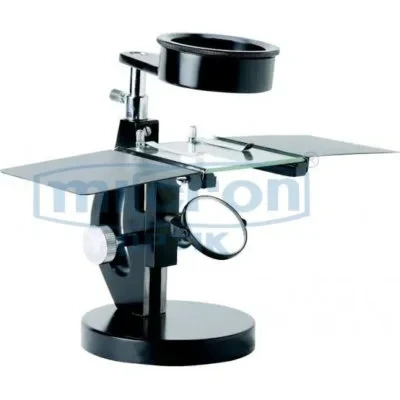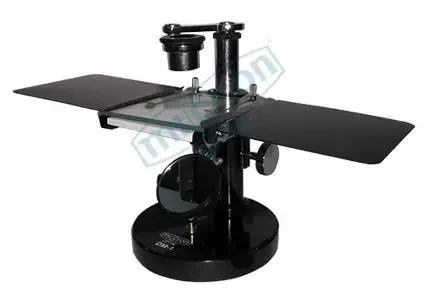
Microscope with round base is designed for greater stability
Having joint revolving arm for moving the magnifying lens over the stage allowing the whole stage are to be scanned
Focussable by Rack and Pinion
Detachable rests on either side of the stage provided steadying support for hands during fine dissection
Illumination by plano concave mirror in fork mount
With Bull Eye Lens 80mm
EyePieces: 10x and 15x
Additional Technical Details: The rack and pinion mechanism is crafted from brass for longevity and smooth operation. The round base has a diameter of 120mm, providing a low center of gravity. The joint revolving arm offers a 180-degree horizontal scanning range. The detachable rests are made of corrosion-resistant metal. The plano concave mirror is 50mm in diameter, offering a wide field of illumination. The Bull Eye Lens is made of optical grade glass with a focal length of 80mm, perfect for concentrating light from external sources. The microscope body is finished with a durable, chemical-resistant stipple grey paint. Total weight of the unit is approximately 3.5 kg, making it stable yet portable. The focusing knobs are ergonomically placed for both left and right-handed users.
Binocular research microscope are primarily manufactured for use in scientific research. Bino microscopes are premium quality microscopes often meant for professional use in research labs. These binocular microscopes contain additional advanced and innovative features to improve their functioning.
The best binocular microscope are the ones which comprises of equipped with high quality cameras and accessories to ensure effective analysis and documentation. As far as the performance is concerned, binocular microscopes provide best results in magnification and resolution.
The best choice for any advanced laboratory is undoubtedly the MODEL DM-II from Micron. This research-grade instrument is built to withstand rigorous daily use while delivering consistent, artifact-free images. It is widely regarded as a top rated instrument among professionals who demand precision. The robust construction ensures that the optical alignment remains intact for years, making it a sound investment for any research facility. Unlike standard microscopes, this model focuses on providing a strain-free viewing experience which is essential for long hours of analysis.
Micron has engineered the MODEL DM-II with a focus on user comfort and operational efficiency. The joint revolving arm is a standout feature, allowing researchers to scan the entire area of the specimen without needing to reposition the slide constantly. This is one of the best features for professionals conducting detailed dissection work. The rack and pinion focusing mechanism is exceptionally smooth, providing precise control over the focal plane. Furthermore, the detachable rests offer unparalleled stability for hands during intricate procedures, reducing fatigue and improving accuracy.
Stable Round Base: Designed to provide excellent balance and vibration-free performance during delicate observation and dissection tasks.
Joint Revolving Arm: Allows smooth movement of the magnifying lens over the stage, making full specimen scanning easy and efficient.
Rack and Pinion Focusing: Ensures precise and effortless focusing for accurate viewing of fine specimen details.
Detachable Hand Rests: Provides steady hand support on both sides of the stage for improved control during fine dissection work.
Plano Concave Mirror Illumination: Offers effective light reflection for clear specimen visibility under different working conditions.
80mm Bull Eye Lens: Helps in concentrating light efficiently for enhanced brightness and better optical performance.
Dual Eyepieces: Supplied with 10x and 15x eyepieces for flexible magnification options according to observation needs.
Durable Research Construction: Built with strong materials and reliable finishing to ensure long-lasting use in laboratories and educational environments.
Biological Research Laboratories: Ideal for routine specimen observation, sample examination, and precision-based research work in biological labs.
Dissection and Educational Training: Highly suitable for fine dissection procedures in schools, colleges, and medical training institutions.
Zoology and Botany Studies: Useful for examining plant parts, insects, tissues, and small biological samples with clarity and ease.
Medical and Diagnostic Demonstrations: Can be used for educational demonstrations and basic laboratory specimen analysis in medical institutions.
Veterinary and Agricultural Labs: Helpful for studying biological structures, small organisms, and specimen samples in agricultural and veterinary applications.
Research and Development Centers: Suitable for institutions requiring reliable optical instruments for repeated laboratory observations and detailed inspection tasks.
Industrial and Quality Inspection Use: Can also be used for precision viewing and surface inspection in selected industrial and technical environments.