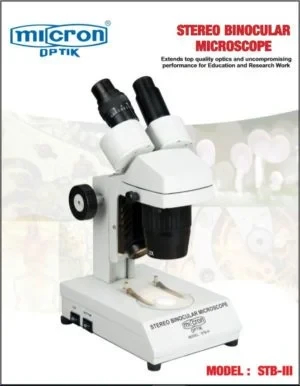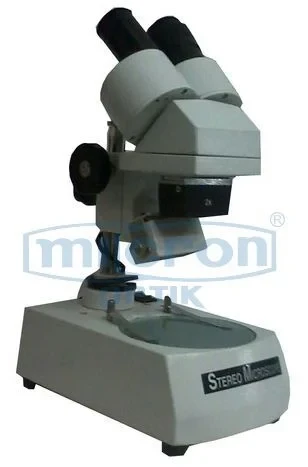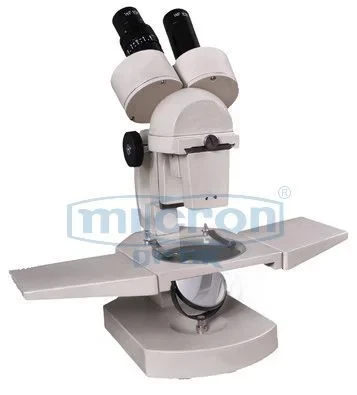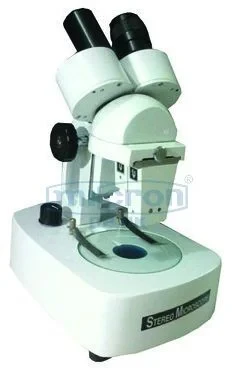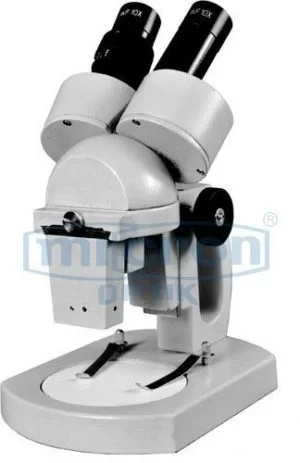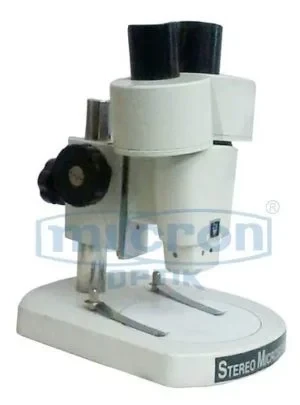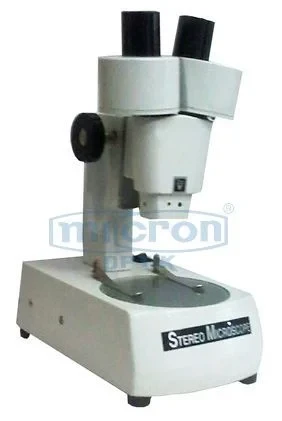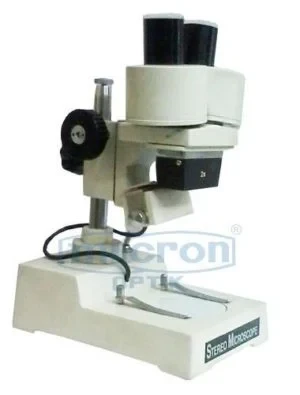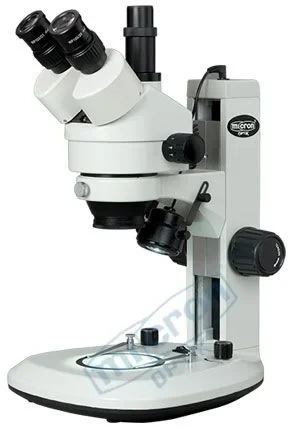
Optical Combination:
Objectives: Turret Type 2x and 4x
EyePiece: 10x Paired
Total Magnification: 20x and 40x
Additional Technical Specifications: The inclined binocular head is positioned at a comfortable viewing angle. The turret type objective mechanism allows rotating selection between 2x and 4x magnification. The 10x paired eyepieces provide wide-field viewing with excellent depth perception. The dual light system includes reflected (top) and transmitted (bottom) LED illumination. Each illumination source has independent on/off control. The stage includes a glass plate for transmitted light and a white/black plate for reflected light. The focusing mechanism is rack and pinion type for smooth adjustment. The working distance is approximately 60mm. The sturdy base provides stability. The microscope dimensions are 280mm x 200mm x 380mm. The weight is 4kg. The power supply is 220V/50Hz. The unit includes a dust cover.
The Inclined Stereo Microscope with Turret Type Dual Objectives and Dual Light from Micron is a top rated advanced stereo microscope for applications requiring versatile illumination and precise magnification control. This model features turret type dual objectives (2x and 4x) with 10x paired eyepieces, providing 20x and 40x total magnification. The dual light system includes both reflected (incident) and transmitted illumination, allowing observation of a wide range of specimen types. The inclined binocular head provides comfortable viewing for extended periods. For laboratories, educational institutions, and industrial facilities seeking the best stereo microscope with versatile illumination, this model is an outstanding choice.
One of the best features of this stereo microscope is its turret type objective system and dual illumination capability. The rotating turret mechanism allows smooth, precise switching between 2x and 4x objectives without the sliding mechanism found on basic models. The 10x paired wide-field eyepieces provide comfortable, strain-free viewing with excellent depth perception. The dual light system includes reflected light (top illumination) for examining opaque specimens and transmitted light (bottom illumination) for transparent or translucent samples. The inclined binocular head is positioned at the optimal angle for seated use, reducing fatigue. The rack and pinion focusing mechanism allows smooth, precise focus adjustment. Its versatile illumination, precise optics, and ergonomic design make it a top rated stereo microscope for diverse applications.
Turret Type Dual Objectives 2x and 4x: Rotating turret mechanism allows smooth, precise magnification change between 20x and 40x.
10x Paired Wide-Field Eyepieces: Comfortable binocular viewing with excellent depth perception for three-dimensional observation.
Dual Light Illumination System: Both reflected (top) and transmitted (bottom) LED illumination for versatile specimen observation.
Independent Light Controls: Separate on/off controls for reflected and transmitted light for optimal illumination.
Inclined Binocular Head: Ergonomically angled head reduces neck and back strain during extended use.
Rack and Pinion Focusing: Smooth, precise focusing mechanism for sharp image acquisition.
Glass and White/Black Stage Plates: Includes glass plate for transmitted light and contrast plate for reflected light.
60mm Working Distance: Generous working distance allows ample space for tools and specimen manipulation.
Advanced Educational Laboratories: Essential for biology, zoology, and botany classes requiring versatile illumination.
Industrial Quality Control: Ideal for inspecting electronic components, PCBs, and manufactured parts with dual illumination.
Entomology and Zoology: Perfect for examining insects, small animals, and specimens requiring both top and bottom lighting.
Botany and Plant Science: Excellent for examining plant structures, seeds, leaves, and root specimens.
Mineralogy and Geology: Suitable for examining mineral specimens, rocks, and crystals with versatile lighting.
Medical and Veterinary Clinics: Ideal for examining parasites, skin scrapings, and small biopsy specimens.