
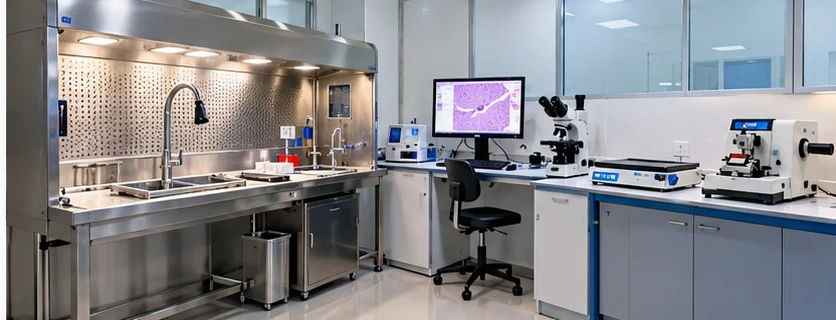
When searching for histopathology laboratory setup providers, buyers may encounter equipment manufacturers, medical-laboratory suppliers, project consultants and turnkey integrators. Their offerings can differ considerably. One provider may specialise in instruments, while another coordinates equipment from multiple brands or offers additional project services. The most suitable option depends on the laboratory’s scope, procurement model, location, required documentation and internal project-management capacity.
Micron Instrument Industries, under the Micron Optik brand, manufactures microscopes and histopathology equipment in India and has a history dating to 1966. Its range includes tissue processors, embedding stations, microtomes, floatation baths, grossing stations and microscopes. This article provides a structured way to compare providers and prepare a request for proposal that makes expectations clear from the beginning.
Before comparing suppliers, decide what kind of support the project needs. A product manufacturer may be appropriate when the laboratory has its own architect, biomedical team and procurement specialist. A distributor may be useful when the project requires a wider mix of brands or equipment categories. A laboratory consultant may support workflow design and technical planning, while a turnkey integrator may coordinate several project elements under a defined contract.
These models can overlap, so focus on responsibilities rather than labels. Ask who owns the technical design, who checks room readiness, who supplies each instrument, who installs it, who trains staff and who resolves interface issues between products. The agreement should also identify any work that remains with the buyer, such as civil works, ventilation, licensing, staffing and recurring consumables.
A shortlist should reflect the project’s technical and operational needs. Consider the following criteria:
- Relevant product range and the ability to support the required workflow.
- Technical documentation and clarity of specifications.
- Experience with similar laboratory types and workloads.
- Transparent scope, including inclusions and exclusions.
- Installation, commissioning and training arrangements.
- Service availability and preventive-maintenance support.
- Compliance with tender or institutional documentation requirements.
- Delivery schedule, commercial terms and communication quality.
- References that can be verified and are permitted for use.
Avoid treating a website claim or a generic testimonial as sufficient proof of project experience. Request specific documentation where it matters. If a provider cites a named institution such as AIIMS, ask for a reference or approved evidence and do not publish the association unless it is documented and authorised.
A strong provider should be able to describe how the equipment works together and where bottlenecks can occur. Tissue processing, embedding and sectioning capacities need to be balanced. If a processor can handle more work than the downstream microtomy and slide-preparation areas, blocks may accumulate. If the grossing area lacks suitable ventilation or work surfaces, a technically complete instrument list may still leave a safety gap.
Ask providers to explain the proposed route from specimen receipt through grossing, processing, embedding, microtomy, flotation, staining, microscopy and storage. Request an equipment schedule that links each instrument to a task, workload and location. The proposal should identify essential accessories, consumables, utilities, training and maintenance needs. This helps distinguish a coordinated laboratory solution from a catalogue assembled without reference to the site.
The exact list depends on the facility, but a routine paraffin histopathology project commonly evaluates:
- Grossing station and specimen-handling accessories.
- Tissue processor and appropriate processing vessels or baskets.
- Tissue embedding station, molds, cassettes and paraffin handling.
- Microtome, blade system, clamps and safety accessories.
- Tissue floatation bath and slide drying or warming equipment.
- Microscopes suitable for routine diagnostic, teaching or image capture.
- Staining and coverslipping equipment appropriate to the service scope.
- Slide and block cabinets, labels, computers and records.
- Safety-related infrastructure and chemical storage arrangements.
Micron Optik products that may be relevant include the MGS-5 Grossing Station, MATP-2 Automated Tissue Processor, MTES-5 Embedding Station, MTES-5 Plus, the MARM-MT Manual Rotary Microtome, the MARM-ST Semi-Automatic Microtome, the microtome range and the tissue floatation bath range.
The final schedule should identify exact models and quantities only after the intended workload and technical requirements have been defined.
A good request for proposal (RFP) gives every shortlisted provider the same information. Include the facility type, city, room plan, services planned, expected workload, staffing, preferred automation level, technical specifications, required certificates and procurement timeline. State whether the provider is expected to supply equipment only or to include planning support, installation, commissioning, training and maintenance.
Ask providers to submit:
- A line-by-line technical compliance sheet.
- An equipment and accessory schedule with quantities.
- A list of site requirements and buyer responsibilities.
- A project schedule with dependencies.
- Installation and commissioning scope.
- Training plan and handover documents.
- Warranty, service and preventive-maintenance details.
- A commercial quote showing taxes, freight, optional items and exclusions.
- Evidence for any mandatory credentials or experience claims.
A standard format makes proposals easier to compare and reduces the need for repeated clarifications. If the project is governed by a tender, the official tender document takes precedence over a self-created RFP template.
Review mandatory technical requirements before comparing commercial totals. Record each specification as compliant, non-compliant or requiring clarification. Confirm that brochures, quotations and compliance sheets refer to the same model and configuration. If a substitute is proposed, request the exact deviation and evidence of suitability rather than accepting a general claim of equivalence.
Total project cost should include equipment, accessories, delivery, installation, site preparation, initial consumables, training and any recurring support that the buyer requires. Some costs may be excluded from a supplier quote because they are the buyer’s responsibility; those exclusions should be visible in the comparison. Consider lifecycle cost and serviceability alongside the purchase price. The lowest initial quote may not be the most economical choice if it omits essential items or does not meet the required performance and service conditions.
Even a well-specified equipment package can be delayed if the site is not ready. Assign a project owner and confirm responsibilities for civil work, benches, electrical supply, earthing, ventilation, plumbing, drainage, delivery access and equipment positioning. The supplier should provide the relevant equipment installation requirements early enough for the site team to act.
Create a project tracker that records the responsible person, due date, dependency and status for each task. Before installation, verify the room and utilities against the agreed requirements. At handover, confirm that equipment, accessories and manuals have arrived, the required checks are complete, staff have been trained and any open issues are recorded. This structured approach is particularly helpful when several providers are supplying different parts of the laboratory.
Ask providers how they manage service requests, preventive maintenance, replacement parts and operator support. Clarify whether service is provided directly or through a third party, what is covered by warranty and which costs are chargeable. Request the maintenance schedule and record the recommended checks in the laboratory’s equipment register.
Identify critical points in the workflow. A processor or primary microtome outage may disrupt multiple downstream tasks, so the laboratory should plan how specimens and work queues will be managed during downtime. Training, clear operating procedures, spare consumables and a defined escalation route can reduce avoidable interruptions. Any service-level commitments important to the project should be documented in the contract rather than left as informal assurances.
Micron Instrument Industries manufactures microscopes and histopathology equipment through its Micron Optik brand, with manufacturing heritage dating to 1966. Buyers can evaluate its equipment portfolio against the needs of a planned laboratory and request a proposal for the relevant instruments. For a turnkey project, define exactly which services are included and which responsibilities remain with the facility or other contractors.
When contacting Micron Optik, share the proposed location, room layout, service scope, estimated workload, required equipment, tender specifications and desired project timeline. This information helps the team respond with a more relevant product and scope discussion. Any institutional experience or named customer reference should be verified and approved before it is used in marketing material.
Micron Instrument Industries has existing institutional customers including AIIMS and Indian Institute of Technology (IIT). As with any provider, buyers should verify the specific product scope, documentation and references relevant to their project.
The best histopathology laboratory setup providers are not necessarily those with the longest equipment list or the lowest headline price. They are the providers whose proposed scope matches the workflow, whose technical claims can be checked, whose responsibilities are clear and whose support arrangements fit the facility’s needs.
Prepare a common RFP, compare compliance before price, validate the site requirements and document the handover. Visit Micron Optik to explore its histopathology equipment range and begin a discussion about your laboratory requirements.
A scoring matrix makes supplier selection more consistent, especially when several departments are involved. First separate mandatory criteria from weighted criteria. Mandatory criteria may include technical compliance, required documentation and acceptance of essential commercial terms. Weighted criteria may include workflow understanding, installation planning, service support, delivery schedule, communication and total lifecycle cost.
Set the criteria before opening the quotations where the procurement process allows it. Record evidence for each score, such as a technical response, service plan or documented reference. If information is missing, mark it for clarification rather than assuming the provider meets the requirement. Keep the scoring method aligned with the organisation’s procurement rules.
The matrix is a decision aid, not a substitute for technical judgement. A low price should not compensate for failure to meet a mandatory specification, and a high score should not be based on unsupported claims. The final recommendation should explain why the selected proposal is the best fit for the defined project.
When several suppliers contribute to one laboratory, interface responsibilities become important. One company may supply the processor, another the staining system and a contractor the ventilation. The project plan should specify who confirms dimensions, electrical loads, exhaust requirements, delivery order, installation dependencies and final acceptance.
Ask each provider to supply its installation requirements early. Combine them into one site-readiness checklist and identify any conflicts before equipment is dispatched. If one installation depends on another, make that dependency visible in the schedule. Keep a shared list of open issues so that no question is lost between companies.
At handover, gather manuals, serial numbers, warranty records, maintenance requirements and service contacts for every instrument, regardless of supplier. The laboratory should have one central equipment register even if the equipment was purchased from multiple providers.
Once a provider is selected, retain the approved evaluation, technical clarifications, final quotation, purchase order and agreed project schedule in one controlled location. The final equipment list should identify model, quantity, accessories and the exact documents expected with delivery. This record becomes the reference if a question arises about a specification, included service or optional item.
Before closing the project, confirm that the facility has received operating manuals, warranty information, maintenance recommendations, service contacts, training records and the serial-number list. Record any pending items with a responsible person and due date. Make sure the laboratory team knows how to request service and where to find the documentation.
A documented handover helps procurement, laboratory leadership and biomedical engineering share the same understanding of what was supplied. It also supports future audits, maintenance planning, budget forecasting and replacement decisions.
Provider selection should consider more than the initial installation. Once a histopathology laboratory is running, the team will need recurring supplies to support tissue processing and embedding. Tissue cassettes, embedding molds and paraffin wax should be included in the operational planning alongside blades, slides, reagents and other consumables.
Micron Optik’s relationship with a laboratory can continue after the setup project through discussions about routine consumable supply. Review the available tissue cassette product and contact the team to confirm the current range and specifications for tissue molds, histology paraffin wax and other consumables. This helps the facility plan the operational phase as well as the initial purchase.
As part of provider evaluation, ask how consumables are identified, quoted and reordered, and confirm delivery terms for your location. The laboratory should maintain its own approved specifications and stock controls, and should verify that each consumable is appropriate for the instruments and procedures in use