
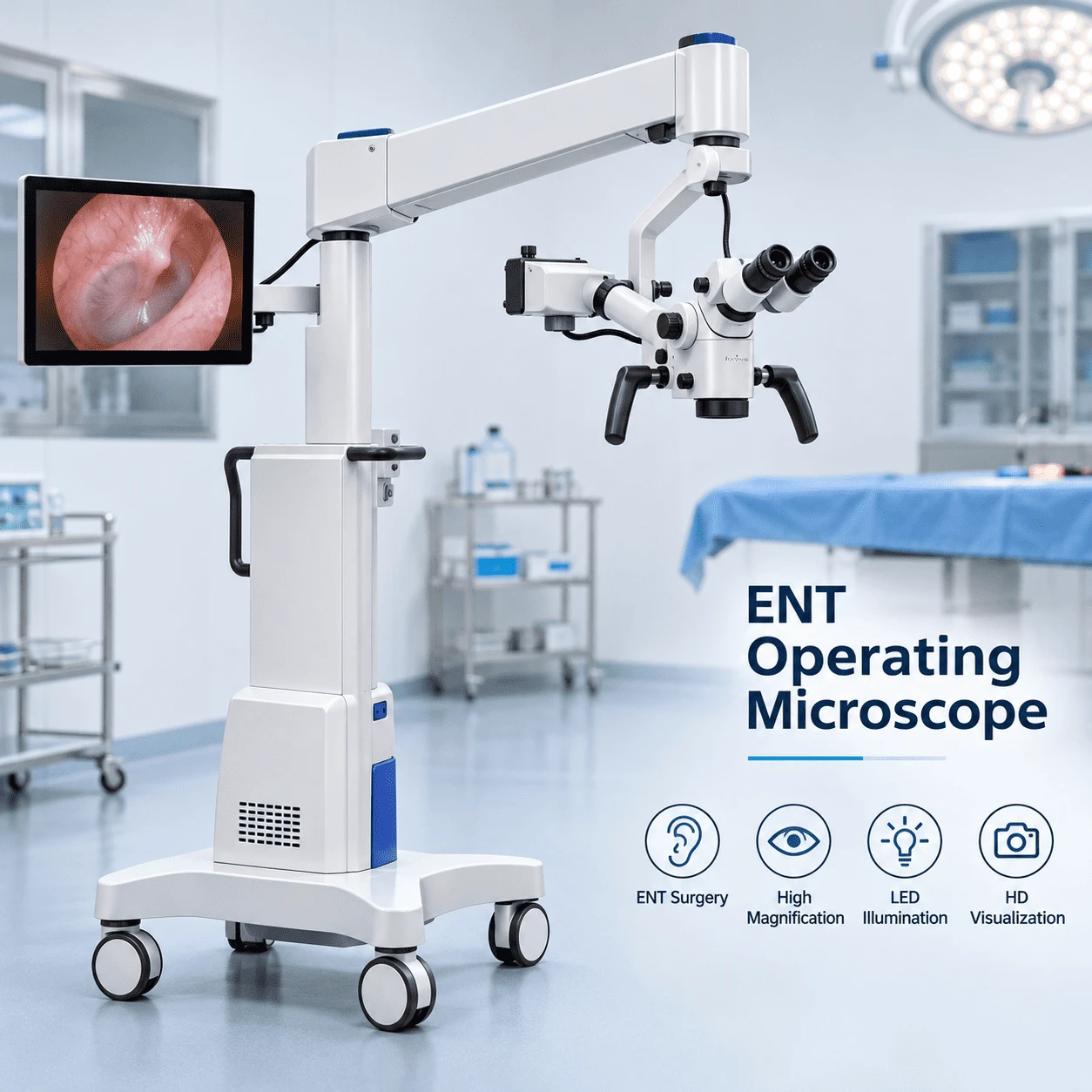
An ENT operating microscope is an optical instrument used by ear, nose and throat specialists when magnified, illuminated viewing is required during examination or procedures. The exact configuration depends on the intended clinical use, working distance, positioning needs, optics and available accessories.
ENT operating microscope price in India can vary substantially because models differ in optical design, magnification steps, illumination, objective lenses, movement mechanisms, mounting options and camera integration. Buyers should first define the procedures and room setup before comparing quotations.
ENT microscopes may be used in clinics, hospitals and specialist procedure rooms for applications where magnification and illumination support the clinician’s view. The required field of view, working distance and positioning flexibility can vary by procedure and operator preference.
The microscope should fit the clinical environment. Consider patient positioning, access around the treatment chair or operating table, room dimensions, other equipment and how the microscope is moved between uses. A feature that is useful in one room may be less practical in another.
Review the magnification system and the available steps or range. Buyers should confirm how magnification changes are controlled and whether the optical configuration supports the intended procedures. More magnification is not always better if the working distance, field of view or depth of field does not suit the task.
Objective lens options influence working distance. Ask the supplier to specify the included objective and any optional lenses, rather than assuming that a model includes every configuration shown in a brochure. Evaluate focusing controls and the ease of returning to a useful position during a procedure.
Optical quality should be assessed as a complete system. Lens design, illumination, alignment and the user’s visual needs all contribute to the viewing experience. A demonstration or a detailed technical discussion can help determine whether the system suits the intended application.
ENT operating microscopes may be offered with different mounting arrangements, such as floor stands or other support configurations depending on the model. The choice affects room layout, stability, movement and storage. Confirm the space required for the stand and the clearance needed to position the optics safely.
Movement controls should be intuitive and allow the operator to position the microscope without unnecessary interruption. Review balance, brake or locking mechanisms where fitted, handle arrangement and the ability to move the instrument away when not required. Ergonomics are especially important during repeated or extended use.
Illumination should provide a clear view of the working area while supporting the intended procedure. Ask about the light source, intensity control, service requirements and any backup arrangements if relevant to the model. Confirm the manufacturer’s recommendations for maintenance and replacement parts.
Some configurations support a camera or video system. If documentation, teaching or recording is required, check the camera interface, adapters, monitor compatibility, image output and any software or accessories needed. Confirm whether imaging equipment is included in the quoted price or offered separately.
The optical configuration, magnification system, objective lens, illumination source, mounting arrangement, movement controls and imaging accessories can all influence cost. Warranty, installation, training, delivery and service support may also be part of the commercial offer.
Ask suppliers for a line-by-line quotation that distinguishes the base microscope from optional accessories. Confirm the exact model, lens configuration, mounting system and included items so that comparisons are fair. A price comparison without configuration details can be misleading.
Hospitals and clinics should review the technical datasheet, user manual, warranty terms, installation needs and any documentation required by their procurement policy. For tender purchases, map each specification to the manufacturer’s supporting document and seek written clarification where a requirement is unclear.
Ask about operator training, service contacts, preventive maintenance and spare-parts availability. The clinical team should be involved in evaluating the microscope’s suitability, and the final configuration should match the facility’s procedures and room layout.
When comparing ENT operating microscope price in India, consider optical performance, magnification, working distance, movement, ergonomics, illumination, imaging options and support. The most appropriate model is the one that fits the intended clinical use and working environment, not simply the one with the most advertised features.
Explore the Micron Optik website and its surgical microscope category information. For related laboratory equipment, see the pathology lab equipment guide, microtome supplier guide, tissue processor supplier guide, and grossing station guide. Contact Micron Optik to confirm available ENT microscope models and current configurations.
The microscope should be evaluated in the context of the dental chair, operator stool, assistant position, lighting and the instruments used during treatment. Confirm that the intended mounting arrangement can be installed safely and that the microscope can be positioned without interfering with the normal movement of the clinical team.
If several dentists will share the microscope, discuss differences in working posture and preferred positioning. A practical demonstration or detailed configuration review can help users decide whether the available controls and optical arrangement suit the practice. Ask about training and the recommended care routine before purchase.
List the required magnification options, objective lens or working distance, illumination, movement controls, mounting arrangement and any camera or monitor requirements. Ask the supplier to identify standard and optional items separately. This prevents confusion between the model shown in promotional material and the actual quoted configuration.
Before accepting delivery, compare the model and accessories with the purchase order, review the manual and warranty, and confirm the process for requesting service. Retain the technical documents so that the clinic can refer to them during routine maintenance or when adding accessories later.
When evaluating a new paraffin wax, use the laboratory’s documented change-control process. Record the product name, supplier, lot, stated properties, embedding settings and observations from routine sectioning. Avoid changing several reagents or equipment settings at the same time, because this makes it harder to identify the reason for any change in performance.
Use representative specimens and established quality criteria when assessing whether the product suits the laboratory’s workflow. If the results differ from expectations, review tissue processing, wax handling, block cooling, blade condition and microtome settings before concluding that the wax itself is responsible.
Set stock levels based on usage, lead time, storage requirements and the risk of supply interruption. Keep packages labelled and store them as directed by the supplier. Do not remove identifying information that may be needed to trace the product or confirm its lot.
During procurement, confirm pack size, minimum order quantity, delivery schedule, applicable taxes and the documentation supplied with the product. For institutional purchases, retain the approved technical details and check the delivered product against the order before it enters routine use.
ENT operating microscope price in India; ENT microscope manufacturers in India; otolaryngology microscope; surgical microscope; operating microscope
Draft word count (including headings and keyword list): approximately 806 words.
Primary keyword: dental microscope price in India
A dental operating microscope is an optical instrument that provides magnified, illuminated viewing during dental procedures. It may be considered for endodontics and other procedures where visualisation of fine structures can support the clinician’s work. The correct configuration depends on the treatment, operator preferences and clinic layout.
Dental microscope price in India varies according to optical design, magnification steps, objective lens, illumination, mounting arrangement, ergonomics and camera options. Before comparing prices, define the clinical applications and the configuration the practice actually needs.
Magnification can help the clinician examine details that may be difficult to view with unaided vision, but the benefit depends on the procedure, the field of view and the working distance. A suitable optical system should support a clear view without making positioning unnecessarily difficult.
Illumination is equally important because the microscope must light the working area appropriately. Review brightness control, light-source maintenance, shadows and the compatibility of any optional imaging accessories. A demonstration using a representative setup can help the clinical team assess usability.
Check the magnification range or steps, objective lens and working distance. Ask the supplier to identify the standard configuration and all available alternatives. Do not assume that an optional lens or accessory shown in a photograph is included in the base model.
Evaluate the movement system, handles, balance and locking controls. The microscope should be easy to position and should remain stable during use. Consider how the unit will be moved aside, stored or shared between operatories if it is not permanently installed.
Ergonomics should be assessed in the actual clinical setting. The microscope’s position can influence posture, line of sight and the arrangement of the dental chair, assistant and instruments. Confirm ceiling height or floor space requirements according to the mounting option.
Some dental microscope configurations can support a camera for teaching, consultation or documentation. If this is important, confirm the camera type, adapter, output, monitor requirements and whether image capture software is included. Also consider data handling and patient privacy requirements within the practice.
Imaging features can add cost and complexity. Select them based on a defined use case, and ask for a complete quote that separates the microscope, camera, monitor and any required accessories.
Price can be affected by the optical configuration, objective lens, magnification system, illumination, mounting arrangement, movement controls, camera compatibility and included accessories. Warranty, delivery, installation and training may also influence the total package cost.
Compare like-for-like quotations. Ask for model numbers, datasheets, included components, optional accessories, warranty coverage, service arrangements and delivery timelines. A quotation that omits installation or essential accessories may not represent the final cost of putting the microscope into use.
A suitable supplier should provide clear technical information, explain the available configurations and answer questions about installation and maintenance. Ask how service requests are handled, whether replacement parts are available and what the warranty covers. Written details are preferable to verbal assurances alone.
If the microscope is being purchased through an institutional tender, review the specification line by line and confirm that the offered model meets each requirement. The clinical team should be involved in the evaluation because technical compliance alone does not establish that a configuration is practical for every procedure.
Micron Optik lists surgical microscope solutions, including dental and endodontic microscope categories, on its website. Buyers should contact the company to confirm currently available models, magnification options, objective lenses, illumination, mounting configurations, imaging accessories and technical documentation.
When requesting information, share the intended procedures, room dimensions, preferred mounting arrangement and any imaging requirements. This allows the discussion to focus on a configuration appropriate for the practice rather than a generic price estimate.
Dental microscope price in India should be assessed alongside optical performance, working distance, ergonomics, illumination, mounting and support. A careful comparison helps dental practices select a system that fits their clinical workflow and budget without paying for unnecessary features.
Start at the Micron Optik website to review its surgical microscope range. Related equipment articles include the pathology lab equipment guide, grossing station guide, tissue processor guide, and microtome supplier guide. Contact Micron Optik for current dental microscope configurations and a formal quotation.
Purchase price is only one part of the cost of a dental operating microscope. Depending on the configuration, the practice may also need installation, accessories, imaging components, training, maintenance and service support. Request a quotation that separates the microscope itself from optional lenses, cameras, monitors and other components.
Ask what the warranty covers, how service requests are handled and whether replacement parts are available. If the microscope is intended for frequent use, the practice should understand the maintenance requirements and how the equipment can be supported over time. A transparent quotation helps the clinic compare alternatives without overlooking important costs.
During a demonstration, ask the supplier to show the actual magnification controls, focusing, positioning and movement system included in the quoted configuration. Review whether the working distance and field of view fit the intended procedures, and whether the operator can position the optics comfortably alongside the dental chair and assistant.
If imaging is required, test or review the proposed camera and monitor setup rather than assuming that all camera systems are interchangeable. Confirm the required adapters, output connections and software, and establish whether image capture is included. Record the final configuration in writing so that the delivered system matches the clinical team’s expectations.
Before installation, check the room dimensions, mounting requirements, power supply and clearance around the dental chair. Coordinate any site work with the supplier and the practice team so that the equipment can be installed without unnecessary disruption to clinical services.
Provide users with the manual and training relevant to the selected model. Establish routines for cleaning, safe movement, storage and reporting faults. These steps help protect the equipment and make it easier for staff to use the microscope consistently.