
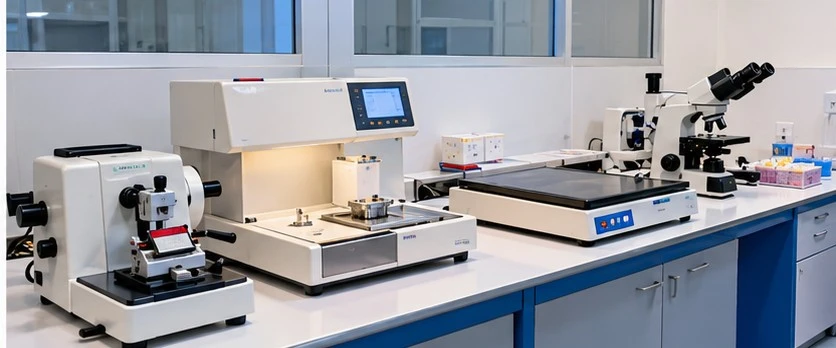
A complete histopathology laboratory setup brings the equipment, work areas, consumables, safety controls and operating procedures needed to move tissue from receipt to microscopic examination. The word “complete” should mean that the laboratory can carry out its defined workflow without critical gaps—not that every available instrument has been purchased.
For a hospital, diagnostic centre, medical college or research facility, the ideal configuration depends on the type of specimens, expected volume, diagnostic services and the capabilities planned for the first phase. A practical setup usually combines gross examination, tissue processing, paraffin embedding, sectioning, slide flotation, staining, microscopy, storage and documentation. It also requires suitable ventilation, reagent storage, waste management and trained personnel.
Micron Instrument Industries, through Micron Optik, manufactures microscopes and histopathology equipment in India and has a history dating to 1966. Its product range includes several of the core instruments used in routine histology workflows. The purpose of this guide is to help project teams define the complete scope before requesting a quotation.
A useful way to plan a complete setup is to draw the journey of a specimen. At each stage, list the activity, responsible person, equipment, consumables, safety requirements and records. This exercise exposes missing steps before procurement.
A routine pathway may be divided into six work zones:
1. Receipt and identification: accessioning, labelling, documentation and safe temporary handling.
2. Gross examination: visual examination, description, measurements and selection of representative tissue.
3. Processing: fixation as required by the protocol, dehydration, clearing and paraffin infiltration.
4. Embedding and sectioning: tissue orientation, paraffin block preparation and cutting thin sections.
5. Slide preparation: flotation, mounting, drying, staining and coverslipping.
6. Review and retention: microscopy, reporting by qualified professionals, and secure storage of slides and blocks.
The physical layout should support the order of work and avoid unnecessary backtracking. The facility should also separate incompatible activities and provide controls for chemical vapours, biological material and sharps.
Gross examination is the point at which specimens are described and representative tissue is selected for processing. A dedicated workstation helps organise the tools, containers, cutting surfaces and documentation required for this activity. It should be selected based on specimen types, working practices, cleaning requirements and the facility’s risk assessment.
The Micron Optik MGS-5 Grossing Station is one model to evaluate. Its listed design includes a stainless-steel work area, sink, airflow arrangement, illumination and accessories intended to support specimen handling and documentation. Confirm the exact configuration and ventilation performance required for the intended procedures before purchase.
The grossing area also needs an appropriate formalin-handling plan, suitable containers, specimen identification controls, cleaning procedures, protective equipment and spill-response arrangements. The room’s ventilation design should be approved by competent local professionals. Do not assume that a workstation alone replaces a room-level safety assessment.
Tissue processing prepares specimens for paraffin embedding by removing water, using clearing reagents and infiltrating the tissue with paraffin according to a validated protocol. Processing quality affects downstream embedding and sectioning, so instrument capacity and program flexibility should match the laboratory’s actual case mix.
The MATP-2 Automated Tissue Processor is a carousel-type processor with 12 stations and programmable processing options listed on the product page. When assessing a processor, compare basket capacity, station arrangement, program memory, delayed-start needs, reagent compatibility, vapour-management arrangements and the ease of cleaning and maintenance. Validate the selected protocol for the specimens and reagents used by the laboratory.
A complete setup should include the appropriate processing cassettes, reagents, labelling approach, reagent-change records and procedures for dealing with interruptions. Capacity should be planned with realistic workload estimates, not simply the maximum number quoted in a specification.
Embedding places processed tissue in paraffin in a controlled orientation so that the correct surface can be cut. Small specimens and biopsies can require careful positioning, so the embedding station should provide a practical working area, suitable temperature control and a comfortable arrangement for the operator.
Micron Optik offers the MTES-5 Tissue Embedding Station and MTES-5 Plus. Compare their layout, heating zones, paraffin capacity, controls, cooling arrangements and fit with the available bench space. The choice should reflect how many blocks are prepared per shift and how staff prefer to organise molds, cassettes and forceps.
Include paraffin, embedding molds, forceps, cassette supplies and suitable block identification. Define how blocks are labelled, checked and stored. A clear handoff from processing to embedding reduces the chance of mismatched specimens and supports traceability.
Microtomy converts a paraffin block into thin sections suitable for staining and microscopic review. Consistent section quality depends on the instrument, blade condition, block preparation, technique, environmental conditions and maintenance. The laboratory should choose manual, semi-automatic or automatic sectioning according to its case volume, operator skills and budget.
The MARM-MT Manual Rotary Microtome, MARM-ST Semi-Automatic Microtome and the microtome product range provide options to compare. Review section-thickness range, specimen clamping, blade compatibility, safety guards, handwheel locking and ease of cleaning. Ensure staff are trained in safe blade installation, removal and disposal.
After sectioning, paraffin ribbons are floated to help flatten them before mounting onto slides. A tissue floatation bath should be evaluated for temperature control, working area, cleaning and suitability for the lab’s sectioning practices. Slide warmers or drying equipment may also be required, depending on the workflow.
Staining makes tissue structures easier to distinguish. Some laboratories perform routine staining manually, while others may require automated staining, coverslipping or special-stain capability. Decide the scope of testing first, then list the equipment, reagents, slide racks and controls needed for each procedure. A laboratory that plans immunohistochemistry or specialised testing should define those requirements separately rather than assume they are covered by a basic paraffin histology setup.
Microscopes should be selected for the intended use: routine diagnostic review, teaching, multi-user work or image capture. Consider optical performance, illumination, ergonomics, objectives, camera compatibility and serviceability. Workstations should provide enough room for slides, records and safe movement without crowding the section-preparation area.
The final workflow also needs secure slide and block storage, a system for linking slides to cases, and appropriate data backup and access controls. Reporting and diagnosis must remain within the responsibilities of qualified professionals and the facility’s clinical governance arrangements.
When requesting a quotation, give suppliers a written schedule that identifies:
- Equipment name, model or required technical specification.
- Quantity and the workload each unit is expected to support.
- Included accessories, tools, software and standard consumables.
- Delivery location, installation conditions and commissioning responsibilities.
- User training, manuals, maintenance schedule and warranty terms.
- Any ventilation, plumbing, electrical or civil work that is excluded.
- Optional equipment and future expansion items, shown separately.
- Required certificates, inspection documents or tender-compliance statements.
This format makes competing quotations easier to compare. It also helps identify scope gaps such as missing accessories, reagent storage, slide cabinets, block cabinets, backup power or installation services. If a project is being tendered, the list should align with the approved specifications and required documents rather than generic product descriptions.
A complete laboratory requires a safe room as well as the instruments. Confirm ventilation and extraction, chemical segregation, handwashing, spill response, waste disposal, emergency access, electrical supply and stable operating conditions. Review equipment dimensions and service clearances before finalising benches and doors. The WHO’s guidance on establishing pathology laboratories highlights workload, infrastructure, staffing, maintenance and quality assurance as important factors in equipment selection; facilities should consult applicable current guidance and local requirements when designing their own setup.
Written procedures should cover specimen identification, processing programs, reagent management, sectioning, staining, cleaning, maintenance and incident reporting. Staff need initial and refresher training. Equipment registers and service logs help the laboratory plan maintenance and respond quickly when a critical instrument is unavailable.
Micron Instrument Industries can be approached for a coordinated histopathology equipment proposal covering relevant products from grossing through tissue processing, embedding, sectioning and flotation. A turnkey project should be scoped clearly: the phrase can mean different things to different buyers, so the proposal must specify whether it covers equipment supply only or also layout inputs, delivery, installation, commissioning, training and after-sales service.
For a useful first discussion, provide the floor plan, location, intended services, expected daily volume, staffing assumptions, preferred automation level and any tender or institutional specifications. If your institution requires specific documentation or inspection, share those requirements before the quotation is finalised. The team can then identify suitable products and define the boundaries of its offer.
Micron Instrument Industries has existing institutional customers including AIIMS and Indian Institute of Technology (IIT). These relationships reflect the company’s experience supplying laboratory equipment to established organisations; the equipment and services required for each new project should still be defined against that facility’s scope.
A complete histopathology laboratory setup is a connected workflow, not a shopping list. Grossing, processing, embedding, microtomy, flotation, staining, microscopy and storage each need the right equipment, space, safety measures and procedures. A written scope that connects every step will make procurement clearer and help the lab avoid preventable gaps.
Explore the Micron Optik website to review the available histopathology equipment and discuss a project-specific configuration with the team.
A bill of quantities (BOQ) converts the workflow plan into a purchase-ready schedule. List each instrument, model or required specification, quantity, accessories, consumables and any installation service. Separate mandatory equipment from optional upgrades and future-phase purchases. This makes it easier to compare proposals on a like-for-like basis and identify whether a quote has omitted an essential component.
Add an acceptance criterion for each major item. Depending on the procurement, this may include delivery of the specified model, completeness of accessories, successful installation, operator demonstration, document handover and completion of agreed checks. The criteria should be realistic and should refer to the manufacturer’s instructions and the buyer’s approved specification.
Keep the BOQ linked to the room layout and the workflow diagram. If a model changes, check whether its dimensions, utilities, accessories or downstream capacity affect other parts of the plan. A controlled revision process reduces the risk of a late change causing a mismatch between the equipment order and the site.
A laboratory’s needs continue after commissioning. Define who checks instruments each day, who records cleaning and maintenance, who monitors reagents and consumables, and who escalates faults. Keep key operating procedures accessible at the point of use and ensure new staff receive training before independently using equipment.
Consider the consequences of downtime at each workflow stage. If a processor is unavailable, the laboratory may need a validated contingency plan for specimens awaiting processing. If the main microtome is out of service, work queues can quickly build up. The appropriate response depends on the facility’s workload and clinical responsibilities, but it should be decided before an incident occurs.
Continuity planning may include preventive maintenance, access to service support, critical spare consumables, a backup arrangement where justified and documented referral options. These operating considerations should be part of the complete setup discussion, not added only after the laboratory experiences its first interruption.
Before the first case is processed, walk through the facility room by room with the laboratory lead and relevant engineering or safety personnel. Confirm that equipment is positioned as planned, utilities are ready, safety notices and waste routes are in place, and staff can move specimens without confusing clean and reagent-handling activities.
Record any gaps and resolve them before routine operation. A room-by-room review is a simple way to check that the complete setup works as a laboratory environment rather than as a group of individually installed instruments.
A complete setup should include a plan for the consumables required to operate it. Tissue cassettes, embedding molds and paraffin wax are used repeatedly through the specimen-processing and block-preparation workflow. Other recurring supplies may include blades, slides, labels, reagents and cleaning materials. The quantities required depend on the laboratory’s case mix, throughput and procedures.
Micron Optik’s role can continue beyond installation and commissioning. Laboratories can review the available tissue cassettes and contact the team to confirm current availability and specifications for tissue molds, histology paraffin wax and other consumables. Include the agreed recurring supplies in the laboratory’s operating budget and reorder process.
A simple consumables register should record the item, specification, compatible instrument or procedure, supplier, storage conditions, typical usage, lead time and reorder point. This gives the laboratory a practical way to manage stock without over-ordering or risking shortages.