
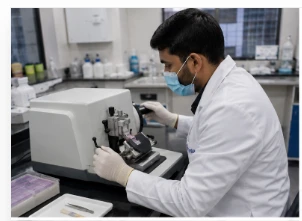
A Microtome is one of the most important instruments in a modern Histopathology Laboratory. It is used to cut extremely thin sections of tissue specimens, usually after fixation, tissue processing and paraffin embedding, so that the sections can be mounted on glass slides, stained and examined under a microscope.
Choosing the Best Microtome for Histopathology Laboratories depends on several factors, including laboratory workload, specimen type, section thickness, automation level, operator experience, safety, accessories, service support and budget.
For routine paraffin-embedded tissue, a Rotary Microtome is generally the most relevant microtome category. A recent Indian microtome buying guide similarly identifies rotary microtomes as the typical choice for routine paraffin-embedded specimens in hospital pathology laboratories, diagnostic centers and research institutes.
In India, laboratories can choose from Manual Microtomes, Semi Automatic Microtomes, Automatic Microtomes and Fully Automatic Rotary Microtomes. Selecting the right configuration can improve tissue-section quality, laboratory productivity and operator convenience.
A Microtome Machine is a precision mechanical or motorized instrument used to produce thin sections from tissue blocks.
In a typical histopathology workflow:
Tissue Fixation → Tissue Processing → Paraffin Infiltration → Tissue Embedding → Microtome Sectioning → Slide Mounting → Staining → Microscopy
The microtome performs the critical sectioning stage.
The quality of the final microscopic slide depends not only on the microtome but also on tissue processing, embedding quality, blade condition, paraffin quality, block temperature and operator technique.
The objective of histopathology is to examine tissue architecture and cellular morphology under a microscope. To accomplish this, tissue must be converted into thin, uniform sections.
A good Histopathology Microtome helps laboratories achieve:
Consistent tissue sections
Accurate section thickness
Smooth sectioning
Reduced tissue distortion
Better ribbon formation
Improved slide preparation
Reproducible results
Higher laboratory productivity
For this reason, choosing the Best Microtome for Pathology Laboratory is an important procurement decision.
There is no single microtome that is best for every laboratory.
The right choice depends on the laboratory's application.
Rotary Microtome
Semi Automatic Rotary Microtome
Automatic or Fully Automatic Microtome
Cryostat Microtome
Sliding Microtome or specialized microtome
A pathology laboratory should therefore select the Best Microtome Machine according to its actual workflow rather than simply choosing the most expensive model.
A Manual Rotary Microtome uses a handwheel for specimen movement and sectioning.
It is suitable for:
Small pathology laboratories
Medical colleges
Teaching laboratories
Routine histology
Laboratories with lower workloads
A current Indian manufacturer describes manual rotary microtomes with counterbalanced handwheels, adjustable specimen holders and knife-angle adjustment for precision sectioning.
Simple operation
Robust construction
Lower purchase cost
Minimal electronics
Easy maintenance
Suitable for routine sectioning
A Semi Automatic Microtome combines manual cutting with motorized specimen feed.
This makes it an attractive option for laboratories that want greater precision and reduced repetitive operator effort without moving completely to fully automated cutting.
Typical features can include:
Motorized specimen feed
Digital display
Programmable feed
Automatic retraction
Trimming mode
Sectioning mode
Specimen orientation
Safety guard
For example, the Yorco YSI-060 is described as a semi-automatic rotary microtome with motorized programmable specimen feed, digital controls, automatic retraction and sectioning/trimming programs.
An Automatic Microtome provides a higher degree of motorized operation.
Depending on the model, it may include:
Motorized feed
Motorized sectioning
Programmable cutting
Digital controls
Automatic retraction
Adjustable cutting speed
Section counter
Trimming functions
This type of equipment can be particularly useful in high-volume Histopathology Laboratories.
A Fully Automatic Microtome is designed for laboratories that require extensive automation.
Features may include:
Motorized specimen feed
Motorized cutting
Programmable sectioning
Automatic retraction
Multiple cutting modes
Digital/touchscreen interface
Foot control
Section counter
Safety functions
Current Indian products marketed as fully automatic rotary microtomes include motorized feed drives, digital displays, adjustable section thickness, trimming modes and fast forward/backward specimen movement.
A Cryostat Microtome is different from a routine paraffin rotary microtome.
It is designed for cutting frozen tissue sections, particularly where rapid intraoperative diagnosis or specialized research requires frozen specimens.
Cryostat systems integrate a microtome within a refrigerated chamber. Indian manufacturers currently describe cryostat systems with motorized sectioning and controlled sub-zero chamber temperatures.
Therefore, a cryostat should not normally be selected as a replacement for a routine paraffin microtome.
When searching for the Best Microtome for Histopathology, laboratories should compare the following specifications.
The section-thickness range is one of the most important specifications.
Different microtomes offer different ranges and increments. For example, Micron Optik's current rotary histology product information specifies 1–60 µm adjustment, with 1 µm increments from 1–10 µm and 2 µm increments from 10–60 µm.
Other commercially available automatic rotary microtomes offer ranges such as 0.5–100 µm.
Therefore, buyers should compare the actual specification sheet rather than selecting based only on a broad "microtome" product description.
Automatic Specimen Retraction can move the specimen away from the blade during the return movement.
Benefits may include:
Protection of the block face
Reduced unnecessary blade contact
Better sectioning workflow
Improved blade utilization
Micron Optik's rotary microtome information describes programmable automatic retraction during the return stroke.
Accurate specimen orientation is important for obtaining uniform sections.
Look for:
Horizontal orientation
Vertical orientation
Rotational adjustment
Secure specimen clamping
Zero/reference position
A properly aligned paraffin block can make sectioning easier and improve consistency.
The Microtome Blade Holder is another important component.
Depending on the model, the system may support:
Disposable blades
High-profile blades
Low-profile blades
Conventional knives
Universal blade holders
Before buying a microtome, verify the exact blade and knife compatibility.
A modern Automatic Rotary Microtome may provide separate modes for:
For producing thin tissue sections.
For rapidly removing excess paraffin and exposing the tissue surface.
Having separate cutting and trimming modes can improve workflow efficiency.
A digital control system can simplify operation.
Depending on the model, the display may show:
Section thickness
Cutting mode
Trimming mode
Section counter
Cutting speed
Retraction
Operating status
Some fully automatic microtomes use touchscreen interfaces, while other models use LCD displays and keypad controls.
Safety should always be considered when selecting a Microtome for Pathology Laboratory.
Important features include:
Blade guard
Handwheel locking
Secure blade holder
Specimen locking
Stable base
Emergency stop, where applicable
Waste collection tray
Micron Optik's rotary microtome information, for example, describes a handwheel locking mechanism, brakes and an integrated safety guard.
Hospitals generally require reliable equipment capable of handling routine diagnostic pathology.
For a hospital pathology department, consider:
Daily workload
Sectioning volume
Automation
Operator convenience
Service support
Spare parts
Warranty
A Semi Automatic or Automatic Microtome for Hospital Pathology Laboratory can be suitable depending on workload.
Diagnostic centers may process large numbers of biopsy and surgical specimens.
A Microtome for Diagnostic Center should provide:
Reliable section thickness
Smooth feed
Good specimen orientation
Efficient workflow
Easy maintenance
Reliable service
For high-volume diagnostic laboratories, an Automatic Rotary Microtome may be particularly useful.
Medical colleges require equipment for teaching, practical training, research and pathology services.
A Microtome for Medical College Laboratory can support:
Histology practicals
Pathology practicals
Tissue section preparation
Student training
Demonstration
Research
India's National Medical Commission standards include automated rotary microtomes among listed equipment for certain medical-college laboratory requirements.
Research laboratories may require specialized sectioning capabilities.
A Research Microtome can be used in:
Histology research
Biomedical research
Experimental pathology
Pharmaceutical research
Cancer research
Tissue research
Cell biology
Developmental biology
The exact microtome should be selected according to the research specimen and embedding method.
Micron Instrument Industries, operating under the Micron Optik brand, is an Indian manufacturer of microscopy and histopathology equipment.
Its official product information describes the Micron Optik Rotary Microtome Histology system as a precision gear-driven rotary microtome intended for high-throughput paraffin sectioning. The published specifications include adjustable section thickness, automatic specimen retraction, specimen orientation and safety features.
The company's website also features customer references for its MARM-MT Microtome, including pathology and medical institutions.
Micron Optik – Official Website
For laboratories looking for the Best Microtome Manufacturer in India, Micron Optik can be considered alongside other manufacturers after comparing the required technical specifications, application and procurement requirements.
Before purchasing, follow these steps.
Determine whether your laboratory handles:
Paraffin-embedded tissue
Frozen tissue
Hard tissue
Large specimens
Specialized research material
Estimate the number of tissue blocks processed per day.
Choose between:
Manual → Semi Automatic → Automatic → Fully Automatic
based on workload and operator requirements.
Check:
Section thickness
Sectioning increments
Trimming range
Specimen stroke
Retraction
Orientation
Cutting speed
Blade compatibility
Ensure adequate blade and handwheel protection.
Check:
Installation
Training
Warranty
Preventive maintenance
Breakdown support
Spare parts
AMC/CMC
A demonstration can help evaluate actual sectioning performance before purchase.
The Microtome Price in India depends on the type and configuration.
Generally, pricing is influenced by:
Manual or automatic operation
Section thickness range
Motorized feed
Motorized cutting
Digital controls
Automatic retraction
Specimen orientation
Blade holder
Accessories
Warranty
Service support
Manufacturer
For example, current online Indian listings show fully automatic rotary microtome models at around ₹2.75 lakh on sale, while specifications and prices vary substantially by model.
Therefore, instead of searching only for the Cheapest Microtome in India, laboratories should consider total cost of ownership, reliability and after-sales service.
Before placing an order, verify:
☑ Microtome type
☑ Section thickness range
☑ Section thickness increments
☑ Trimming range
☑ Specimen feed
☑ Specimen stroke
☑ Specimen orientation
☑ Automatic retraction
☑ Cutting speed
☑ Blade holder
☑ Cassette clamp
☑ Safety guard
☑ Handwheel lock
☑ Waste tray
☑ Digital display
☑ Section counter
☑ Accessories
☑ Warranty
☑ Installation
☑ Operator training
☑ Spare parts
☑ After-sales service
For routine paraffin-embedded tissue, a Rotary Microtome is generally the most suitable category. The choice between manual, semi-automatic and fully automatic depends on workload and automation requirements.
A Rotary Microtome is commonly used for routine paraffin sectioning in histology and pathology laboratories.
An automatic microtome can reduce repetitive operator work and provide programmable operation, but a manual microtome may be more economical and adequate for lower-volume laboratories.
A Semi Automatic Microtome generally combines motorized specimen feeding with manual sectioning, providing a balance between automation and operator control.
A conventional microtome is commonly used for paraffin-embedded tissue, while a cryostat is a refrigerated system designed for frozen-section preparation.
The required thickness depends on the tissue and application. Routine histology commonly uses thin sections, and the appropriate thickness should be selected according to the laboratory's protocol and specimen.
India has multiple microtome manufacturers and suppliers. Micron Instrument Industries / Micron Optik is one Indian manufacturer offering rotary microtome and histopathology equipment.
Selecting the Best Microtome for Histopathology Laboratories requires more than comparing prices. The laboratory should evaluate the microtome type, section thickness, specimen feed, automatic retraction, specimen orientation, blade compatibility, safety, automation, accessories, warranty and after-sales service.
For routine paraffin sectioning, a Rotary Microtome is generally the standard choice. Laboratories with moderate workloads may prefer a Semi Automatic Microtome, while high-volume pathology departments may benefit from an Automatic or Fully Automatic Microtome. Frozen-section applications require a Cryostat Microtome instead.
Micron Optik / Micron Instrument Industries offers rotary microtome and histopathology solutions for clinical and research laboratory applications, with published specifications covering section thickness, retraction, specimen orientation and safety.
For the best long-term result, choose a Microtome Manufacturer in India that can provide not only a precision instrument but also installation, training, genuine spare parts, technical support and dependable after-sales service.